Author Archives: Amy Karnes

  1. We’re Great Place to Work Certified—And Here’s What That Really Means

    Comments Off on We’re Great Place to Work Certified—And Here’s What That Really Means


    We have some thrilling news to share: K2M Design has officially earned the prestigious Great Place to Work Certification™! This is a significant achievement that we all can take pride in.

    But here’s the thing—this isn’t just another plaque for the wall or a badge for our website (though we’re definitely adding that badge). This recognition means something much more significant: it’s proof that we’re building the kind of workplace we all want to be part of.

    What Is Great Place to Work Certification?

    You might be wondering what precisely this certification means. Unlike many workplace awards that rely on applications or self-reported data, Great Place to Work Certification is based entirely on anonymous feedback from our employees. That means the people who work here every day, across all departments, all levels, had their say about what it’s really like to work at K2M Design.

    This year, 90% of our team members said K2M Design is a great place to work. To put that in perspective, that’s only a 5% difference from the average of U.S. Best Small & Medium Workplaces. Even more powerful? 100% of our employees agree that K2M treats all employees fairly—regardless of race, ethnicity, or sexual orientation. That kind of consensus doesn’t happen by accident. It reflects our unwavering commitment to equity, respect, and belonging at every level of the organization.

    Great Place to Work® is the global authority on workplace culture, and earning this Certification means we’ve met its rigorous standards for creating an exceptional employee experience.

    “This recognition matters because it comes from our people,” states Steve Grasley, CEO of K2M Design. “It tells me that trust, relationships, and purpose match our drive for excellence, which we continue to foster. That is a true high-performance culture.”

    What Makes K2M Design Stand Out

    So what exactly makes K2M Design a great place to work? Here are some of the things our team told us matter most:

    Flexibility: We provide a flexible work schedule and an open paid time off (PTO) policy, along with various options for remote and hybrid work.

    Trust: We cultivate a high level of trust among our employees, empowering them to complete their work with minimal oversight. For instance, we encourage open communication, provide autonomy in decision-making, and offer support for personal and professional development.

    Why This Matters for Job Seekers

    If you’re reading this and thinking about your next career move, here’s something worth noting: according to Great Place to Work research, job seekers are 4.5 times more likely to find a great boss at a Certified workplace. Employees at Certified companies are also:

    • 93% more likely to look forward to coming to work
    • Twice as likely to be paid fairly
    • Twice as likely to earn a fair share of company profits
    • Twice as likely to have a fair chance at promotion

    We’re Just Getting Started

    While we’re incredibly proud of this achievement, we’re not resting on our laurels. We see this Certification as a milestone, not a finish line. Our commitment to continuous improvement, listening to feedback, and making K2M Design an even better place to work is unwavering.

    Thank you to everyone who contributed to this achievement—and to those considering joining our team, we’d love to have you. Check out our open positions and see if K2M Design might be the right fit for your next chapter.

    Check out our Open Positions Here
     

  2. Meet the Directors: Lori Kreke, NCIDQ

    Comments Off on Meet the Directors: Lori Kreke, NCIDQ

    At K2M Design, we believe that our people are our most valuable resource, and Lori Kreke exemplifies this philosophy in her role as Director of Interior Design. Her approach to balancing strategic thinking with hands-on problem-solving perfectly reflects K2M’s mission of Building Relationships Based on Trust and Results, not just with clients, but within our own team. In this spotlight, Lori shares insights into her daily work, her passion for developing talent, and the practical wisdom that drives both individual and collective success at K2M.

    What is a typical day like for you?

    As Director of Interior Design, my day is a balance of big picture strategy and in-the-moment problem-solving. I’m checking in with project teams, reviewing design concepts, and ensuring our work aligns with the client’s vision, goals, and schedule. I also spend time mentoring designers, coordinating with the other Directors, and making sure our studio processes run smoothly. No two days are ever exactly the same — some days are more creative, others are about management and coordination.

    What is your favorite part of your role?

    My favorite part is mentoring and empowering our designers, helping them grow their skills, and watching them bring their own creativity and expertise to the table.

    What are some things you do to stay productive and focused?

    I try to plan my day in blocks — dedicate certain hours to creative work, meetings, and admin time so I can give each my full attention, make space for uninterrupted focus of “on the business” work, and prioritize communication with regular, short check-ins with the team to prevent last-minute crises.

    What is one piece of advice you’d give to those aspiring to work in your field?

    Immerse yourself in every part of the design process — not just the creative side, but also the technical details, project management, and the business side. Stay curious, ask questions, and be willing to take on challenges outside your comfort zone. The strongest designers are those who can pair creativity with practical problem-solving and clear communication.


  3. The Shift Towards Flexible Spaces in Hotel Design: A Smart Decision in Modern Hospitality

    Comments Off on The Shift Towards Flexible Spaces in Hotel Design: A Smart Decision in Modern Hospitality

    As the hospitality industry evolves in response to changing guest expectations and market dynamics, one design decision has emerged as particularly significant: the creation of flexible spaces within hotels. This trend is reshaping how hotel owners conceptualize their properties, emphasizing versatility to cater to a diverse range of needs and experiences.

    Flexible spaces are designed to adapt to various purposes, enabling hotels to transform common areas, guest rooms, and meeting venues according to guest requirements. This adaptability is particularly important in our post-pandemic world, where communal areas and multi-functionality are increasingly valued.

    Incorporating flexible spaces allows hotels to accommodate a broader clientele—business travelers looking for meeting spaces that can double as social hubs, families wanting rooms that can adapt as their needs change, or event planners seeking venues that can transform from intimate gatherings into larger receptions.

    Design elements play a crucial role in facilitating this flexibility. Modular furniture, movable walls, and multi-use areas are key components in creating environments that can easily shift between different functions. For instance, a conference room may feature retractable walls to open up into a pre-function area to create a large event space, or a lounge area could be transformed into a co-working space with minimal effort.

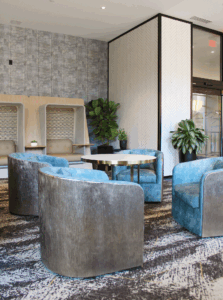
    For example, the Tempo Louisville Hotel, designed by K2M Design, features a flexible meeting space as a part of the hotel lobby. The overall meeting space can be left open and used informally for collaboration or focused individual work in specialized “pods”.  Conversely, the back half of the space can be closed off by two glass pivot doors and easily reserved by guests for more scheduled, dedicated meetings.  In addition, the Technology includes a large TV/monitor for presenting and opportunities for plugging in, or casting, with devices or laptops.

    Additionally, hotels are increasingly recognizing the importance of technology in supporting these flexible designs. Smart systems can adjust lighting, acoustics, and layout configurations based on the current use of the space, making it easier for guests to customize their experiences.

    This focus on flexibility not only enhances guest satisfaction but also contributes to operational efficiency. By designing spaces that serve multiple functions, hotel owners can maximize their property’s potential and respond more effectively to fluctuating demand, thus adding to the potential additional income the hotel can generate.

    Ultimately, the choice to prioritize flexible spaces in hotel design reflects a broader commitment to enhancing the guest experience, embracing versatility, and staying competitive in a rapidly changing hospitality landscape. As more hotel owners recognize the importance of this design decision, it is likely to become a defining characteristic of modern hotel interiors, paving the way for innovative and guest-centric environments.